BREAKING NEWS

Breaking News - Career Updates
📢 Latest Job & Exam Updates — CareerInformationPortal.in BREAKING NEWS: TOP CAREER UPDATES MARCH 2026 🏥 MPESB Group 5 Paramedical Recruitment 2026: 291 Posts (Staff Nurse, Lab Technician, Pharmacist & Others) | Last Date: 27 March 2026 | Apply Now 🏦 IDBI Bank JAM Recruitment 2026: Junior Assistant Manager Grade 'O' (Approx. 1300 Posts) | Last Date: 19 March 2026 | Urgent Application 💊 UPSSSC Pharmacist Recruitment 2026: 560 Posts | Last Date: 29 March 2026 | PET 2025 Scorecard Required 🚌 UPSRTC Bus Conductor Recruitment 2026: Contractual Posts (District-Wise) | Applications Open – Check Last Date by Region 📚 HPSC PGT Computer Science Recruitment 2026: 1672 Teaching Posts | Last Date Extended/Closed – Check Status 🎓 NTA NSSNET 2026: Navayug School Admission Online Form | Last Date: 18 March 2026 | Exam: 10 April 2026 🔬 DRDO CEPTAM-11 Admit Card 2026: Out for CBT-1 on 23 March 2026 (764 Vacancies) | Download Immediately 📊 UPPSC PCS Mains Result 2026: Declared with Category-Wise Cut-off | Check Sarkari Result ⚖️ Jharkhand High Court Assistant Clerk Result 2026: Shortlisted Merit List Out | Download PDF 📄 SSB HC (Ministerial) PET/PST Admit Card 2026: Released | Download & Prepare UPSC Civil Services IAS 2024 Reserve List Marks – Out | Latest Sarkari Update MP Police HC & ASI Online Form 2026: Category-Wise Posts & Syllabus | Application Window Open 🔗 Full Details & Applications: https://www.careerinformationportal.in ✨ Stay Updated – Bookmark for Daily Sarkari Naukri Alerts. 🙏

CAREER JOB

JOB CAREER HUB
For ALL GOVT& PRIVATE JOBS

APNA CAREER

EDUCATION CAREER HUB
For ALL GOVT& PRIVATE JOBS | CBSE BOARD | MP BOARD| ALL COMPETITIVE EXAMS | ALL BOARD | School Exams

Followers

LATEST JOB IN MONTH

APNA CAREER - Download App & Join Channel

⬇ Download App

FM Rainbow India - LIVE Radio

Click the button below to play or pause the live stream.

WhatsApp Join LIVE Channel
Sample Papers 2025-26

APNA CAREER

Apna Career

Career Information Portal - Latest Updates

Wednesday, December 31, 2025

RSSB Patwari Final Result 2025 – Declared


RSSB Patwari Final Result 2025 – Declared


The Rajasthan Staff
Selection Board (RSSB), also known as RSMSSB, has officially declared the Patwari Final Result 2025 on 31 December 2025. This result pertains to the
recruitment drive for 3705 Patwari posts
in Non-Scheduled (Non-TSP) and Scheduled (TSP) areas. The final selection
follows the written examination held on 17 August 2025, provisional result
announcement on 3 December 2025, and document verification conducted from 8 to
15 December 2025.

Candidates can access
the final merit list, selected candidates' PDF, and category-wise cut-off marks
on the official website: rssb.rajasthan.gov.in. The result is available in
PDF format, with separate lists for Non-TSP and TSP areas containing roll
numbers and names of selected candidates. No login credentials are required.

Key Highlights of RSSB Patwari Recruitment 2025

Particulars

Details

Recruiting Body

Rajasthan Staff Selection Board (RSSB/RSMSSB)

Post Name

Patwari

Total Vacancies

3705

Exam Date

17 August 2025

Provisional Result Date

3 December 2025

Document Verification

8–15 December 2025

Final Result Declaration

31 December 2025

Selection Process

Written Exam + Document Verification

Result Format

PDF (Merit List with Roll Numbers/Names and Cut-Off Marks)

Official Website

rssb.rajasthan.gov.in

Important Keywords for Search

  • RSSB Patwari Final Result 2025
  • Rajasthan Patwari Result 2025
  • RSMSSB Patwari Merit List 2025
  • Patwari Final Cut Off 2025
  • Rajasthan Patwari Selected Candidates List
  • RSSB Patwari Non-TSP Result 2025
  • RSSB Patwari TSP Result 2025
  • Patwari Bharti 2025 Final Result

How to Download RSSB Patwari Final Result 2025 PDF

  1. Visit the official RSSB website: rssb.rajasthan.gov.in.
  2. Navigate to the "Results" or "News & Notifications" section on the homepage.
  3. Click on the relevant links for "Patwari Final Result 2025" (Non-TSP/TSP) and "Final Cut-Off Marks".
  4. The PDF will open; use Ctrl+F to search your roll number or name.
  5. Download and save the file for future reference.

Selected candidates are
advised to monitor the official website for further updates regarding
appointment letters, district allotment, and joining instructions.
Congratulations to all successful candidates.

For the most accurate
and updated information, refer directly to the official RSSB portal.


Smart Mirrors for Virtual Fitness Coaching


Smart Mirrors for Virtual Fitness Coaching

Introduction

In contemporary lifestyles, maintaining physical fitness presents significant challenges due to demanding schedules, limited access to traditional gyms, and disruptions such as global health crises. Smart fitness mirrors have emerged as a transformative solution, integrating advanced technology into home environments to facilitate virtual fitness coaching. These devices appear as conventional full-length mirrors when inactive but activate to reveal high-resolution interactive displays. Equipped with cameras, sensors, and artificial intelligence (AI), they deliver live or on-demand classes, real-time form correction, and personalized workout plans.

MAGIC AI Raises $5M for Fitness Mirror | Fitt Insider
Smart Mirrors for Virtual Fitness Coaching

As of 2025, the smart fitness mirror market has experienced substantial growth, with estimates projecting values ranging from approximately USD 359 million to higher figures, driven by increasing demand for connected home fitness solutions. This article examines the underlying technology, key benefits, prominent models, potential limitations, and future developments in this innovative sector.


Smart Mirror Gym The Mirror Reviews Workout Smart Mirror Reviews ...
Technology Behind Smart Fitness Mirrors

Smart fitness mirrors employ a combination of hardware and software components to create an immersive coaching experience. The core structure consists of a reflective surface overlaid with a high-definition LCD or LED display, typically ranging from 40 to 60 inches. When powered off, the device functions as a standard mirror; activation transforms it into a digital interface.

Key technological features include:

  1. Cameras and Motion Tracking: Most models incorporate wide-angle or 3D depth-sensing cameras capable of tracking multiple body joints (often 32 or more). Computer vision algorithms analyze user movements in real time, enabling accurate repetition counting and posture assessment.
  2. Artificial Intelligence for Form Correction: AI processes visual data to provide immediate feedback, such as verbal cues or on-screen overlays highlighting improper alignment. Advanced systems, like those using proprietary technologies (e.g., ReflectAI or Motion Engine), score form quality numerically and suggest adjustments to enhance safety and efficacy.
  3. Audio and Connectivity: Integrated speakers, Bluetooth compatibility for heart rate monitors or headphones, and Wi-Fi enable seamless streaming of classes. Some devices support gesture controls or voice commands for hands-free operation.
  4. Personalization and Integration: Machine learning adapts workouts based on user performance, goals, and progress. Integration with wearables or smart home ecosystems allows tracking of metrics like heart rate and calories burned.

These elements collectively replicate the guidance of a professional trainer, reducing injury risks and optimizing results.

Benefits of Smart Mirrors for Virtual Fitness Coaching

Smart fitness mirrors offer numerous advantages over traditional gym memberships or standalone video workouts:

  • Convenience and Accessibility: Users can exercise at home without commuting, scheduling constraints, or exposure to crowded facilities. This is particularly valuable for individuals with busy routines or those preferring privacy.
  • Personalized Coaching: Real-time AI feedback ensures proper technique, which is critical for preventing injuries and maximizing effectiveness—features often absent in pre-recorded videos.
  • Variety and Motivation: Extensive libraries include diverse classes (e.g., strength training, yoga, HIIT, cardio, pilates), live sessions, and community features like leaderboards to foster engagement.
  • Space Efficiency: Wall-mounted or freestanding designs occupy minimal floor space while doubling as decor.
  • Health Monitoring: Integration with biometric devices provides comprehensive progress tracking, including body composition estimates in select models.
  • Cost-Effectiveness Long-Term: Initial investments are offset by eliminating recurring gym fees, though subscription models for content access apply.

Studies and user reports indicate improved adherence to fitness routines, with many achieving consistent results comparable to in-person training.

Popular Models in 2025

Several brands dominate the market, each with distinct strengths:

  • Lululemon Studio Mirror: Known for its sleek, minimalist design and boutique-style classes. It emphasizes cardio, yoga, and bodyweight workouts, with optional personal training via camera. Pricing starts around USD 1,495, plus a monthly subscription.

Is This $1,895 Home Workout Device Worth It? I Tried The Mirror ...
Smart Mirrors for Virtual Fitness Coaching


  • FORME Studio: Features a touchscreen with high-resolution 4K display and options for integrated resistance training. It supports one-on-one virtual coaching and a broad class variety.

FORME Studio LIFT connected fitness mirror has a built-in weight ...
A Smart Mirror for Lifters? Forme's Lift Gives You 200 Pounds of Total  Resistance

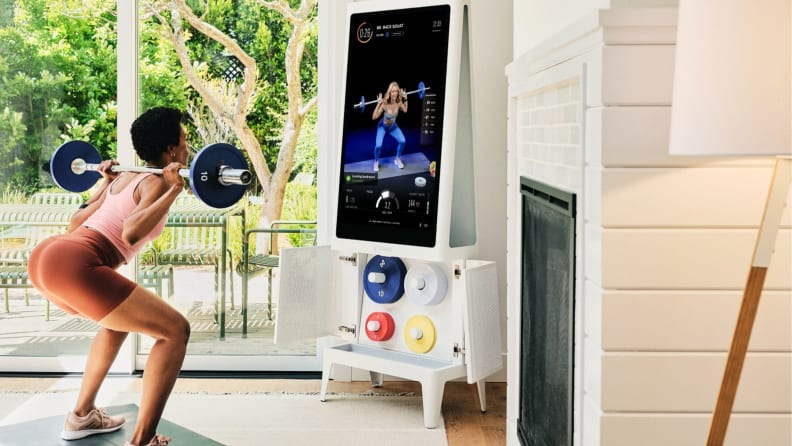
  • Tempo Studio: Excels in strength training with bundled smart weights and advanced 3D tracking for precise form feedback. It includes storage for equipment and personalized programs.


Tempo Studio Review: This workout mirror brings a personal trainer ...

  • NordicTrack Vault: A freestanding unit with built-in equipment storage, utilizing iFit for guided workouts. It appeals to users seeking an all-in-one solution.


NordicTrack Vault Complete Home Gym Mirror – 360 Fitness Superstore

  • MAGIC AI Mirror and Fiture: Emerging leaders with robust AI for gesture control, rep scoring, and hyper-personalized plans. MAGIC stands out for lifetime content access without ongoing subscriptions.

Other notable options include Echelon Reflect (budget-friendly) and Tonal (wall-mounted digital weights, though less mirror-focused).

Comparisons highlight trade-offs: strength-oriented models like Tempo or Tonal prioritize heavy lifting, while others focus on versatility.

Challenges and Limitations

Despite their advantages, smart fitness mirrors present certain drawbacks:

  • High Initial Cost: Devices range from USD 1,000 to over USD 3,000, plus subscriptions (USD 39–50 monthly for most).
  • Subscription Dependency: Access to premium content often requires ongoing fees, though some models offer lifetime inclusion.
  • Space and Installation Requirements: Wall mounting or dedicated areas are needed; professional installation may add expenses.
  • Technical Issues: Connectivity problems, software glitches, or limited form correction in entry-level models have been reported.
  • Market Consolidation: Several popular models (e.g., original Mirror variants, NordicTrack Vault in some regions) have faced discontinuation or reduced availability by late 2025.
  • Privacy Concerns: Camera usage raises data security questions, though reputable brands implement encryption.

These factors necessitate careful evaluation based on individual needs and budget.

Future Prospects

The smart fitness mirror sector is poised for continued expansion, with projected compound annual growth rates of 6–17% through 2030, depending on market analyses. Advancements may include enhanced AI for predictive coaching, augmented reality overlays, deeper integration with health apps, and subscription-free models. Social features, such as virtual group classes or community challenges, are likely to increase motivation.

career information portal ...


Quantum-Safe Encryption for Everyday Apps: The Necessity of Post-Quantum Cryptography


Quantum-Safe Encryption for Everyday Apps: The Necessity of Post-Quantum Cryptography

In the rapidly evolving landscape of digital security, the emergence of quantum computing poses a profound threat to conventional cryptographic systems. Post-quantum cryptography (PQC), also known as quantum-resistant encryption or quantum-safe cryptography, represents a critical advancement designed to protect data against attacks from future quantum computers. As everyday applications—ranging from messaging platforms and mobile banking to email services and cloud storage—increasingly rely on encryption for user privacy and data integrity, the integration of quantum-safe encryption has become essential. This article explores the necessity of post-quantum cryptography, the vulnerabilities of current systems, NIST-standardized algorithms, implementation in consumer applications, challenges, and future outlook.

The Quantum Threat to Current Encryption

Modern public-key cryptography, foundational to secure communications, depends on mathematical problems that are computationally infeasible for classical computers to solve. Algorithms such as RSA and Elliptic Curve Cryptography (ECC) rely on the difficulty of integer factorization and discrete logarithms, respectively. However, Peter Shor's algorithm, executable on a sufficiently powerful quantum computer, can solve these problems exponentially faster, rendering RSA and ECC vulnerable.

Quantum computers leverage principles of superposition and entanglement to perform parallel computations, potentially breaking widely used encryption in minutes or hours rather than millennia. Although cryptographically relevant quantum computers (CRQCs) do not yet exist as of December 31, 2025, progress in quantum hardware suggests they may emerge within the next decade or two. A more immediate concern is the "harvest now, decrypt later" (HNDL) attack strategy, where adversaries collect encrypted data today for future decryption. Sensitive information transmitted via everyday apps—such as financial transactions, health records, or personal communications—could be compromised retroactively.

Symmetric encryption algorithms like AES remain relatively secure against quantum attacks, as Grover's algorithm provides only a quadratic speedup, mitigated by doubling key sizes (e.g., AES-256). The primary vulnerability lies in asymmetric cryptography used for key exchange and digital signatures in protocols like TLS, which secures web browsing, app updates, and API calls.

The Necessity of Post-Quantum Cryptography

The transition to quantum-resistant encryption is imperative for maintaining trust in digital ecosystems. Governments and standards bodies recognize this urgency: the U.S. National Institute of Standards and Technology (NIST) has led a multi-year standardization process, culminating in the release of initial post-quantum cryptography standards in 2024, with further advancements in 2025.

Post-quantum cryptography algorithms are based on mathematical problems believed to be resistant to both classical and quantum attacks. These include lattice-based, hash-based, code-based, and multivariate problems. NIST's efforts ensure interoperability and vetted security, encouraging widespread adoption.

For everyday apps, quantum-safe encryption protects against future threats while preserving current functionality. Without migration, applications risk exposing user data to quantum-enabled adversaries, leading to breaches in privacy, financial security, and national infrastructure.

NIST Post-Quantum Cryptography Standards

NIST's Post-Quantum Cryptography Standardization Project, initiated in 2016, evaluated dozens of candidates through rigorous rounds of analysis. In August 2024, NIST published the first three Federal Information Processing Standards (FIPS):

  • FIPS 203: Module-Lattice-Based Key-Encapsulation Mechanism (ML-KEM), derived from CRYSTALS-Kyber. This is the primary recommendation for general encryption and key establishment.
  • FIPS 204: Module-Lattice-Based Digital Signature Algorithm (ML-DSA), derived from CRYSTALS-Dilithium. Recommended for most digital signature needs.
  • FIPS 205: Stateless Hash-Based Digital Signature Algorithm (SLH-DSA), derived from SPHINCS+. A backup for signatures, offering high security with conservative assumptions.

Additional standards include FIPS 206 (in development) for FN-DSA (based on FALCON), a lattice-based signature alternative. In March 2025, NIST selected Hamming Quasi-Cyclic (HQC), a code-based key-encapsulation mechanism, as a backup to ML-KEM, diversifying mathematical foundations to hedge against unforeseen breakthroughs.

These algorithms provide security levels comparable to current standards (e.g., ML-KEM-768 offers approximately 128-bit security). Hybrid approaches—combining classical and post-quantum algorithms—are recommended during transition to maintain backward compatibility.

Key Post-Quantum Algorithms and Their Suitability

The leading post-quantum cryptography algorithms vary in performance, key sizes, and use cases:

  • Lattice-Based (e.g., ML-KEM/Kyber, ML-DSA/Dilithium): Efficient with small keys and fast operations. Ideal for resource-constrained devices like smartphones. Kyber excels in key exchange for TLS handshakes, while Dilithium provides robust signatures.
  • Hash-Based (e.g., SLH-DSA/SPHINCS+): Extremely secure but larger signatures. Best for long-term archiving or where conservatism is prioritized.
  • Code-Based (e.g., HQC, Classic McEliece): Strong against quantum attacks but larger keys. HQC offers balanced performance as a backup.

Performance analyses in 2025 show that optimized implementations of Kyber and Dilithium incur minimal overhead—often comparable to or faster than ECC at higher security levels—making them practical for everyday apps.

Implementing Quantum-Safe Encryption in Everyday Applications

Integrating quantum-resistant encryption into consumer applications requires crypto-agility: systems designed to switch algorithms seamlessly. Protocols like TLS 1.3 support hybrid key exchange, incorporating ML-KEM alongside classical methods.

Major platforms have begun adoption:

  • Browsers (e.g., Chrome) and libraries (e.g., BoringSSL) support post-quantum key exchange.
  • Messaging apps like Signal have implemented hybrid quantum-safe encryption.
  • Mobile OSes (iOS, Android) provide frameworks for developers to use quantum-safe APIs.

For app developers, libraries such as liboqs (Open Quantum Safe) facilitate prototyping. In VPNs, email (S/MIME, OpenPGP), and IoT devices, post-quantum upgrades enhance end-to-end security.

Case studies demonstrate feasibility: Telecom operators integrate PQC into 5G authentication, while financial apps use Kyber for secure transactions. Performance impacts are mitigated through hardware optimizations (e.g., AVX2 instructions), with handshake latencies increasing marginally.

Challenges in Adoption

Despite progress, barriers remain:

  • Performance Overhead: Larger keys and computations in some algorithms (e.g., code-based) affect bandwidth and battery life in mobile apps.
  • Migration Complexity: Inventorying cryptographic assets and prioritizing high-risk systems (e.g., long-lived data) is resource-intensive.
  • Interoperability: Hybrid modes ensure compatibility but require coordinated updates across ecosystems.
  • Standardization Timeline: Full deprecation of vulnerable algorithms is planned by 2035, with high-risk transitions earlier.

Organizations should conduct cryptographic inventories, test prototypes, and adopt crypto-agile architectures.

Future Outlook and Recommendations

By 2030, widespread post-quantum cryptography deployment is anticipated, driven by regulatory mandates (e.g., NSA CNSA 2.0) and industry initiatives. Ongoing research addresses additional algorithms and optimizations.

Recommendations for stakeholders:

  1. Prioritize migration for applications handling sensitive or long-term data.
  2. Implement hybrid cryptography immediately.
  3. Leverage NIST standards and open-source tools.
  4. Monitor advancements, including potential backups like BIKE or isogeny-based schemes.

NIST Post-Quantum Cryptography Standardized Algorithms Comparison

The following tables summarize the key NIST-standardized post-quantum cryptography algorithms as of December 31, 2025. These are based on the published FIPS standards and ongoing developments.

Table 1: Overview of NIST PQC Standards

Algorithm

Original Name

FIPS Standard

Type

Mathematical Basis

Status

Primary Use Case

ML-KEM

CRYSTALS-Kyber

FIPS 203

Key Encapsulation Mechanism (KEM)

Lattice-based

Published (2024)

General encryption and key establishment

ML-DSA

CRYSTALS-Dilithium

FIPS 204

Digital Signature

Lattice-based

Published (2024)

Primary digital signatures

SLH-DSA

SPHINCS+

FIPS 205

Digital Signature

Hash-based

Published (2024)

Backup signatures (conservative)

FN-DSA

FALCON

FIPS 206

Digital Signature

Lattice-based (NTRU)

In development

Alternative signatures

HQC

HQC

Draft planned

Key Encapsulation Mechanism (KEM)

Code-based

Selected (March 2025)

Backup KEM for diversification

Table 2: Key Sizes and Artifact Sizes (Approximate, Level II/III Parameters for ~128-192 bit Security)

Algorithm

Parameter Set

Public Key (bytes)

Private Key (bytes)

Ciphertext/Signature (bytes)

Notes

ML-KEM

ML-KEM-768

1,184

2,400

1,088

Efficient; recommended primary KEM

ML-KEM

ML-KEM-1024

1,568

3,168

1,568

Highest security level

ML-DSA

ML-DSA-65

1,952

~2,528

3,309

Balanced performance

ML-DSA

ML-DSA-87

2,592

~4,032

4,595

Highest security

SLH-DSA

SLH-DSA-128f

~32

~64

~17,000

Large signatures; very conservative

HQC

Level III

~4,500-7,000

~9,000

~4,500-7,000

Larger than ML-KEM; code-based backup

Notes on Sizes:

  • Values are approximate based on standard parameter sets and implementations.
  • Lattice-based algorithms (ML-KEM, ML-DSA) offer the best balance of size and performance for everyday applications.
  • Hash-based (SLH-DSA) signatures are significantly larger, suitable for limited-use scenarios.
  • HQC provides mathematical diversity but with increased overhead compared to ML-KEM.

Table 3: Performance and Suitability Comparison

Algorithm

Performance Characteristics

Overhead vs. Classical (e.g., ECC/RSA)

Suitability for Everyday Apps

Strengths

Challenges

ML-KEM

Fast key generation/encapsulation/decapsulation

Low to moderate

High

Efficient on mobile devices

Slightly larger keys/ciphertexts

ML-DSA

Fast verification; moderate signing

Moderate

High

Good balance

Larger signatures than ECDSA

SLH-DSA

Slow signing; fast verification

High (large data)

Limited

Extremely conservative security

Very large signatures

HQC

Balanced but slower than lattice-based

Higher than ML-KEM

Moderate

Diversification

Larger keys; draft stage

the necessity of adopting post-quantum cryptography for quantum-safe encryption in everyday applications, such as secure messaging, mobile banking, and cloud services. ML-KEM and ML-DSA are recommended as primary choices due to their efficiency and standardization status, enabling robust protection against future quantum threats while minimizing impact on performance. Organizations should prioritize hybrid implementations during transition to ensure compatibility and security.


Sarkari Result